
WEB & SEO
Where Is All Your Traffic?
Pretty Website. Traffic Ghost Town.
May 24, 2026 · 9 min read

Website Builder SEO Problems
Why Nobody Can Find You
Your new website looks amazing. Your cousin said so. Your neighbor said so. Google has not said anything yet, and that is the problem we need to talk about.
You did everything right. You picked a template. You uploaded your logo. You wrote something in the "About Us" box that sounded professional. You connected your domain, clicked publish, and sent the link to everyone in your contacts. A few people clicked it. They said it looked great and you waited for the customers to arrive.
The customers did not arrive.
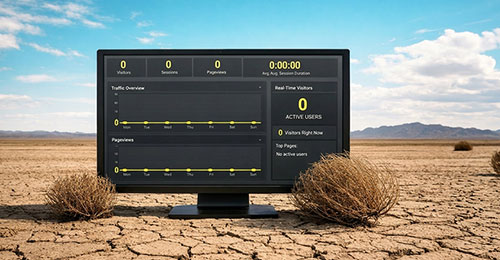
So you refreshed your analytics. One visitor on Tuesday. Three on Thursday, two of which were probably you. A brief spike on the day you sent the email blast that has since completely evaporated. And Google, which is where approximately 92 percent of all web searches happen, has not sent you a single person. Not one. Well...there were 3 visitors from other distant countries, but we'll save the hacker conversation for another blog post.
This is not a story about a bad website. This is a story about what "launching a website" actually means versus what most people think it means. And there is a significant gap between those two things that nobody in the ready-made website builder industry is particularly motivated to explain to you, because if they explained it, you might realize you need more help than a $29 per month subscription provides.
We are motivated. So let us explain.

Launching a website and getting found on Google are two completely separate events
When you hit publish on a website builder, your site goes live on the internet. That is real, and it matters. Anyone who has the direct link can find you. Your mom can find you. Your LinkedIn connections can find you. The people who already know you exist can absolutely find you.
What does not happen automatically is that Google discovers your site, understands what it is about, decides it is trustworthy and relevant, and starts showing it to strangers who are actively searching for what you offer. For those of you who aren't in "the know" about search terms, that process is called search engine optimization, or SEO for short. And, it unfortunately does not come bundled with your subscription, no matter what the homepage of your builder cheerfully implies.

Consider your website as the house. SEO is how people find your house. Building a beautiful house and then wondering why nobody is knocking on the door is understandable. It is also extremely common and fixable, which is the good news we are building toward.
"Launching a website is an event. Getting traffic from Google is a process. One takes a weekend, while the other takes strategy, consistency, and someone who has SEO experience."
Why Website Builders Quietly Underdeliver on SEO
To Google's eyes, your Wix site, without additional SEO enhancements, might as well be written in invisible ink. Google only sees part of it. Your template design is there, your logo is perfectly placed, and all of the pages that you've created are showing up. Even the carefully chosen stock photo of a woman smiling while eating salad is absolutely there. Google just cannot see it.
To be fair to Wix, Squarespace, GoDaddy, and the rest of the cheerful builder gang: they are not lying when they say they have SEO tools built in. They absolutely do. The problem is what those tools actually do, which is handle the very basics of on-page setup while leaving the harder and more important work entirely up to you, without necessarily mentioning that the harder work exists.
Most builders let you edit your page titles and meta descriptions, generate a sitemap, and make your site mobile responsive. These things are necessary and all very important. They are also table stakes, not a complete SEO strategy. Getting them right does not make you rank. It just means you are not actively penalized for getting them wrong, which is a much lower bar than most people realize.
What the builder does not do is figure out what your potential customers are actually searching for and structure your pages around those specific queries. They don't build authoritative content that earns rankings over time, fix slow load speeds, give you meaningful control over URL structures or redirect rules, or help you earn links from other credible websites. Those last ones are particularly important, and we are going to come back to them shortly.
In other words, here's what your website builder quietly skipped
AI-generated Websites Deserve Their Own Conversation
Durable builds you a complete website in 30 seconds. Framer AI generates a fully designed site from a single sentence. Wix ADI asks five questions and hands you something that looks like a real business. These tools are genuinely impressive, and getting something live fast is sometimes exactly the right move.
But here is the thing nobody mentions in the marketing materials: if you can build your website in 30 seconds with one prompt, so can every single one of your competitors. The AI draws from the same patterns, the same content structures, the same design conventions, and produces something that is competent and generic by definition. Generic does not rank. Google's entire job is to surface the most useful and original result for a specific query. A page that reads like it was written by an AI for a hypothetical business in your category is not going to outrank a page that was written by someone who actually understands your specific customers, your specific market, and the specific language those customers use when they are looking for you.
The AI content problem in plain language
If you typed "create a website for a private label food manufacturer" into Durable, and your competitor did the same thing, you would both get websites with nearly identical structure, similar copy, and comparable layouts. Google sees both. Google ranks the one that has built more authority, more specific content, and more relevance to actual search queries.
Back to our house analogy...The AI builds the house, but the strategy determines who finds it.
A Quick and Honest Look at the Major Platforms
Every one of these platforms will tell you they are SEO-friendly. Every one of them is telling some version of the truth. What they mean is that they will not actively sabotage you. What they cannot promise is that they will get you found. There is a meaningful difference, and here is where each one actually stands.
Wix
The most SEO-capable of the major builders. Good meta controls, sitemap generation, and improving tools. The unstructured editor can produce messy code and mobile layouts sometimes need manual attention.
Decent starting pointSquarespace
Clean, beautiful and reliable for basics. Hits a ceiling quickly for advanced strategy. Limited URL control and no support for large-scale content architecture or complex page structures.
Fine for basicsGoDaddy Builder
Fast to set up and aggressively marketed. SEO tools are thin. No redirect control. No URL customization worth speaking of. Their own support engineers have been documented recommending users switch to something else. That is a thing that actually happened.
We have concernsDurable AI
Impressive for speed. Built-in basics like meta tags and mobile responsiveness. Content is generic by design and highly similar across users in the same category. Great for getting live fast. Not a traffic strategy.
Launch tool, not SEO toolFramer AI
Beautiful output, especially for design-forward brands. Requires more manual SEO setup than other builders. Better for brand presence than traffic-driven business sites without significant additional SEO work layered on top.
Gorgeous, needs SEO work10Web AI
Built on WordPress, so it has stronger SEO capabilities. AI handles the build, you keep full WordPress flexibility underneath. Best of the AI builders, but requires some know-how in order to fully implement SEO strategies.
Strongest AI optionThe Small Things That Are Actually Not That Small
Don't get us wrong, we're not saying that if you don't spend a bazillion dollars on a custom-developed, meticulously crafted website, that your site will spend the rest of its life in an internet dungeon. We get it, sometimes time and budget constraints happen. Or, perhaps you're just testing a business model to see if it can get off the ground. Either way, these website builders have potential value and can benefit a business that may not be ready for all the bells and whistles of a custom site. No, we've never charged a bazillion dollars for a website, we're sure of that. And yes, we have helped customers with SEO strategies while using these website pre-made templates.
What we are saying is that beyond the big strategy details, there are a handful of practical items that most builder sites completely ignore, or just don't happen to mention at all. Each one is a missed opportunity. Together, they add up to a site that Google quietly dismisses. The good news is that some of them you can even implement yourself to help your site get found.

When you upload a photo named IMG_4827.jpg, Google has no idea what it is looking at. When you upload chocolate-fudge-brownie-protein-bar-packaging.jpg, you have given Google a meaningful signal about the content of that page. Rename your images before uploading. Use hyphens between words, keep it descriptive, and keep it reasonably short. Your camera's default names are doing nothing for you.
Every image on your site should have alt text, which is the short description that tells Google and screen readers what the image shows. It is an accessibility requirement and an SEO signal in one. It does not need to be a novel. "Custom developed protein powder" is perfect. "Image_001" is not. And do not stuff it with keywords. Google will notice, and it will NOT be pleased.
Your meta title is the blue clickable headline that appears in Google search results. It is a direct ranking factor, and it should contain your primary keyword. Your meta description is the small text snippet beneath it. It is not a direct ranking factor, but it is your one chance to convince someone to click your result instead of the ones above and below it. Google rewrites meta descriptions about 70 percent of the time anyway, but writing a good one still matters. Think of it as the pitch, not the ranking.
Your Google Business Profile is the single most important free SEO tool available to a local business, and an alarming number of businesses have either not claimed it or left it half-finished. A complete, active Google Business Profile with accurate information, real photos, and genuine reviews is one of the most powerful local ranking signals that exists. The name, address, and phone number on every listing must match exactly. Not approximately, exactly.
Getting found online matters just as much as what people see when they actually arrive. If your brand colors look mighty fine online, but not so impressive in print, then that's an entirely different kind of invisible. Check out our blog post all about brand colors for help with that.
The $3 Fiverr Backlink Gig We Should Discuss
If you have ever searched for ways to improve your Google ranking and stumbled across a Fiverr listing offering 10,000 backlinks for three dollars, you have encountered one of the internet's most reliable ways to make your SEO situation significantly worse. We say this with genuine warmth and no judgment because the pitch is genuinely compelling. Backlinks are a real and important ranking factor. More backlinks sounds like it would mean more ranking. Ten thousand of them for three dollars sounds like an extraordinary deal.
It is not a deal. It is a trap with a money-back guarantee written in very small print.
Here is what is actually happening when someone sells you 10,000 backlinks for three dollars. They are using automated software to drop links to your site in blog comment sections, random forum threads, low-quality directory listings, and networks of fake websites that exist only to sell links. These links come from sites with no real traffic, no real authority and no relevance to your business whatsoever. A link from a spam site to your local business does not tell Google you are trustworthy. It tells Google you are desperate, which is a different signal entirely.
Google's spam detection has become sophisticated enough to identify these patterns with striking accuracy. The March 2024 core update specifically targeted manipulative backlink profiles. Sites that built their backlink profiles on cheap bulk links have seen rankings disappear overnight. Recovering from a Google penalty takes months of manual work and sometimes thousands of dollars in cleanup costs. The math on that three-dollar investment works out very poorly.

A real backlink comes from a credible website in a relevant industry that links to your content because it is genuinely useful. You earn those through great content, genuine outreach, industry relationships and showing up as a real expert in your space. It takes longer, but lasts forever. The other approach takes three dollars and three to twelve months of recovery.
WHAT REAL BACKLINKS ACTUALLY LOOK LIKE
A local news outlet covers your business and links to your website. A food industry publication cites your blog post in their resources section. A CPG trade association lists you in their member directory. A satisfied client's website links to you in their vendor section. These are the links that build real authority. They come from doing good work and making sure people know about it. No software or $3 required.
A Free Diagnosis Before The Real Fun Starts
Before you panic because you have zero website traffic, before you call your nephew who "knows about websites," and before you spend money on anything, spend twenty minutes with these free tools. They will show you exactly if and how invisible you are, what your competitors are doing that you are not, and whether anyone on earth is actually searching for what you think they are searching for. Consider it a free X-ray. What to do with the results is where things get more interesting, but at least you will know what you are dealing with.
The most important tool on this list and completely free, directly from Google. Connect your site and you will see exactly which search queries are bringing people to your site, which pages are getting impressions versus clicks, your average position in search results and any technical issues Google has flagged. Most small business owners who log in for the first time discover they are appearing in searches they had no idea about, usually on page four, which is its own kind of news.
Check your trafficYour traffic dashboard. Shows where your visitors come from, how long they stay, which pages they visit and where they leave. Pair it with Search Console and you start to see the full picture of how your site is actually performing versus how you hoped it was performing. If you do not have both of these set up, that is the first conversation to have.
Check your trafficLives inside Google Ads but you do not need to run a single ad to use it. Type in any keyword and it shows you how many people are actually searching for it each month. This is where a lot of businesses discover that the phrase they built their whole site around gets forty searches a month while a slightly different version gets forty thousand. Useful to know before you write another word of content.
Find what people search forShows every question real people are searching for around any topic. Type in "supplement packaging" or "food label design" and you get a full map of what your potential customers are wondering about and typing into Google. One of the most useful content planning tools that exists. The free version gives you enough to be genuinely helpful and genuinely humbled.
Find what people search forShows the relative search interest for any term over time and by region. Great for understanding whether interest in your category is growing or shrinking, whether your topic is seasonal, and what related terms are rising in popularity. Also genuinely fun to explore at eleven o'clock at night when you should be doing other things.
Find what people search forGives you a limited but useful free view of your ranking positions, your domain authority score and keyword data. Type in a competitor's URL and get a snapshot of their estimated traffic, their top-ranking pages and the keywords they are ranking for. The free version has daily limits but is enough to get a clear directional picture of where you stand.
See your rankingType in any competitor's website and see their estimated traffic, their top traffic sources, which pages are performing best and what keywords are driving their visitors. The free version is limited in depth but enough to understand whether your competitor has cracked something you have not, or whether everyone in your space is equally invisible and the opportunity is wide open.
See your competitorsSpecializes in competitive keyword research. Type in a competitor's URL and see what they rank for organically, what content is working for them and what gaps exist that you could fill. A few minutes on SpyFu will give you more content ideas than a full afternoon of staring at a blank page wondering what to write about next.
See your competitorsThe pattern you will notice across all of these tools is the same: the data is clear, the problem is visible and the solution requires actual strategy and expertise to execute. That is not an accident, it's how SEO works. The tools show you the gap. Closing it is a different job entirely.
So, What Does Actually Work?
The good news is that the problem is entirely solvable. The solution is not mysterious. It is just work that requires knowing what you are doing and having a platform flexible enough to do it properly.
Keyword research that starts with your actual customers. Not broad terms like "doctor's office" but the specific phrases real people type when they need what you offer. "Protein Food Manufacturer in CA." "Private Label Supplements, Florida." "Top Commercial Realtor in Tampa." Those phrases have real search volume from people with real buying intent, and a site built thoughtfully around them has a genuine chance of ranking.
Page content written for humans first, search engines second. Good SEO copy is not stuffed with keywords. It is useful, specific and genuine. It answers the questions your customers are actually asking. It demonstrates expertise. It gives Google a clear signal about exactly what you do and exactly who you do it for.
A content strategy that keeps the site active. A blog, resource library, case studies or industry insights. Regular content gives Google reasons to keep crawling your site and gives real people reasons to share it, link to it and return to it. This post is part of ours. That is not a coincidence.
Technical fundamentals done right from the start. Fast load times, clean URL structures, proper redirects, mobile optimization that actually works. Schema markup that helps search engines understand your content, image file names and alt text that mean something. A Google Business Profile that is complete, accurate and actively maintained. These are not glamorous. They are necessary.
"The honest answer to "which platform is best for SEO" is: the one that gives you the most control over your content and technical setup, paired with an actual strategy for using that control. The platform is the vehicle. The strategy is the driver. A Ferrari with no driver goes nowhere, but a determined driver in a reliable car goes very far indeed."
Your Website Deserves More Than a Ghost Town
If you built your site on a builder, and you are staring at analytics that look like a desolate parking lot at 2 am, that is not a verdict on your business. There is a gap between what the builder promised and what SEO actually requires. The site exists. The strategy does not yet.
We build websites and SEO strategies from the ground up, the kind where both are considered together from the very first conversation rather than treated as separate problems solved by separate people who never talked to each other. If your current site has the bones but not the traffic, that is a conversation worth having about what a proper rebuild could look like. If you are starting fresh, even better.
If your cousin says your website looks great, but you have no traffic, let us get Google to agree.
— Triple e Digital, Clearwater, FL. Building websites with the SEO baked in from day one with stragies that make sense for your specific business.
