
PRINTING
Print Marketing Status Update
Print Isn't Dead. It Just Dresses Better Now.
May 9, 2026 · 9 min read

Print Marketing Is Alive and Well
(We've got the proof)
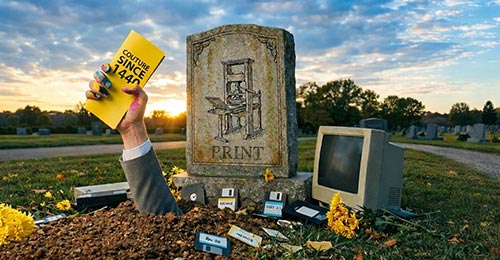
Somewhere around 2010, the internet decided that print was dead.
The eulogies were written. The think pieces were published, ironically, many of them on paper, by people who apparently did not notice the irony. Marketing budgets shifted. Agencies pivoted hard toward digital. Brands that had spent decades building beautiful, tactile, memorable print campaigns quietly redirected their money toward banner ads that approximately nobody was clicking on, because let's be honest, nobody has clicked on a banner ad with genuine enthusiasm since 2007.
Print, we were told, was over. A relic. The eight-track tape of the marketing world. Charming in a nostalgic way, harmless enough as a memory, but completely finished as a serious business tool in a world that had moved on to screens.
We are a design and print agency based in Clearwater, Florida, and we have been in the print business for 30 years. We were on press when the internet was still trying to figure out how to load a JPEG in under four minutes and AOL was still making that demonic screeching sign-on noise. We are genuinely, deeply, perhaps slightly smugly pleased to report that print is not dead. It is not even slightly unwell. It is, in fact, dressed better than it has ever been, performing better than it has in years, and quietly making a lot of digital-only marketing strategies look like they might want to reconsider some of their life choices. This is that story. Buckle up.
First, let's talk about the environmental elephant in the room...
We know what some of you are thinking. We've heard it in client meetings, at networking events, and once memorably from someone at a backyard barbecue who had very strong feelings about forests. "But what about the trees?" The implication being that print is not just dead but also environmentally problematic and therefore doubly guilty of crimes against both marketing budgets and the natural world.
We love the enthusiasm for trees. We really do. Here in Clearwater, we are surrounded by some genuinely spectacular Live Oaks, and we have a personal favorite named Gerald who lives at the end of our street and is doing absolutely magnificently. Thank you for asking. And we would like to offer everyone who has made the environmental argument against print some genuinely good news...
GOOD NEWS FOR GERALD AND ALL OF HIS TREE FRIENDS
87% of marketing mail is recycled, according to current industry data. Paper is one of the most recycled materials on the planet. Additionally, the paper industry plants more trees than it actually harvests. Modern print production uses sustainable forestry practices, recycled content, and vegetable-based inks at rates that would genuinely surprise most people. Meanwhile, the energy required to power the data centers running all those digital ads and streaming platforms is... substantial. We're not saying digital is bad for the environment; we'll leave that to the future's history books. We're simply stating that the comparison is considerably more complicated than just "paper bad, pixels good."
Now that we've addressed Gerald's well-being and the well-being of all his tree friends, let's get into the actual argument.
A brief history of things the internet confidently declared dead
Before we get into the print numbers, it's worth establishing a pattern. "Print is dead" did not happen in isolation. The internet has been declaring beloved things dead for decades with remarkable confidence and a genuinely terrible track record.
Things declared dead. Status report: all present, all thriving.
Radio
Declared dead: 1920s, 50s, 90s, 2005. Still here. Podcasts are just radio with better branding and a Patreon.
Vinyl Records
Declared dead: 1988. Now outselling CDs for the third year running. Hipsters are vindicated and insufferable about it.
Bookstores
Declared dead: 2010. Independent bookstores have been opening faster than they close every year since 2020.
Movie Theaters
Declared dead: 2020. Turns out people still very much want to sit in the dark with strangers eating overpriced popcorn.
Handwriting
Declared dead: every year since 1995. Journals, planners, and fancy pens are now a multi-billion-dollar industry.
Declared dead: 2010. 161% ROI in 2025. $73.57 billion market in 2026. Still here. Dressed better than ever.
The pattern is consistent every single time. A new technology arrives, someone declares the old thing dead, the old thing quietly keeps doing its job extremely well for the people who never stopped believing in it, and then the numbers eventually prove everyone right who stayed the course. Print is the latest entry in a very long list. And it is doing genuinely, measurably fine.
Let's Talk About The Numbers. Because, WOW!
Here is the part that tends to make people put down their phones and stare into the distance for a moment. We say this as an agency that does both print and digital with equal enthusiasm and zero axe to grind either way. We just like things that work. And these numbers are the definition of that.
The most current data from the ANA (Association of National Advertisers) and the DMA (Data & Marketing Association) 2025 Response Rate Report, the most authoritative source in the industry, shows direct mail pulling a 4.4% average response rate. Email sits at 0.12%. That means direct mail is 37 times more effective than email by response rate alone. Thirty-seven times. That is not a rounding difference. That is a completely different category of performance, wearing the same marketing budget conversation.
Direct mail response rate. Email=0.12%. That's 37 times more effective than email.
Direct mail ROI in 2025. Highest of any paid marketing channel. Yes, ANY channel.
The average number of seconds a direct mail piece receives. A TV ad gets 13.8 seconds.
Average time a mail piece lives in someone's home. An email lives until the next scroll.
That 17-day number deserves its own moment because it's the one that never fails to land in a room. A single well-designed printed piece can sit in someone's home, on their counter, on their desk, on their fridge, for nearly three weeks... quietly doing work the whole time. Meanwhile, an email that doesn't get opened in the first hour has roughly the same chance of being read as a message in a bottle thrown into Tampa Bay. 36% of consumers have an actual dedicated spot in their home where they collect and save print pieces that interest them. Nobody has a dedicated spot for marketing emails. Nobody.
And then there's the one we love most of all, the one we pull out when someone in a meeting says "but young people are all digital now": 91% of Gen Z, the generation born between 1997 and 2012, say they have made a purchase after receiving direct mail. 82% of Millennials view print ads as more trustworthy than digital. 63% of Gen Z report being more excited about direct mail than they were a year ago. More excited about physical mail... From the generation that grew up on TikTok. Mind blown, KABOOM!
Why Does Print Work So Well in a World Drowning in Screens?
The short answer is: because it's physical. And physical turns out to matter in ways that are not just sentimental but genuinely neurological. Temple University conducted research for the US Postal Service using actual brain scanning technology, because apparently "does mail work" is now a neuroscience question, which we find absolutely delightful. What they found is that physical materials engage more of the brain's processing power, create stronger memory associations, and trigger greater activity in the part of the brain associated with perceived value and desire. In plain English: your brain works harder for print, remembers it better, and wants what it's selling more. That is not a marketing opinion. That is biology.
It also explains the recall numbers. Print marketing generates a 70 to 80% higher recall rate than digital advertising. In a world where the average person encounters somewhere between 4,000 and 10,000 advertising messages per day, being the thing someone actually remembers is not a small competitive advantage. It is, genuinely, the whole game.

And the trust factor is the one that gets quietly glossed over in most conversations about print versus digital, and it absolutely should not be. 71% of people say mail feels more personal than digital communication. 82% of Millennials trust print more than digital ads. Nearly half of all internet users now run ad blockers, which means a significant portion of your digital budget is being spent on ads that are literally never seen by the people you're targeting. Print has no ad blocker. It shows up. It gets opened. It gets 132 seconds of undivided attention on average. And it gets remembered.
What Print Does That Digital Genuinely Cannot
Print Didn't Survive. It Evolved. And Got a Serious Glow-up in the Process.
This is the part that people who dismissed print tend to miss entirely. The print that exists today is not the print of 1995, or even the print of 2010. The brands and agencies using print well right now are using it in ways that are smarter, more targeted, more beautifully produced, and more strategically integrated with digital than anything that came before. Print got a glow-up. A serious one. And it happened quietly, while everyone was busy writing its obituary.
The catalogs being produced right now by brands like Patagonia and IKEA, well, IKEA, until they made the famously regretted decision to discontinue their catalog in 2021 and were immediately flooded with customers asking for it back, which is its own beautiful argument for print, are genuine objects. Things people keep, reference, and display. Patagonia's catalogs function as environmental storytelling as much as product marketing. People save them. That is not an accident. That is a brand decision made by people who understand what print can do that a website simply cannot.
Direct mail has gotten personal in ways that weren't possible before. Variable data printing means the piece arriving in your mailbox can be customized by purchase history, geography, and behavioral data. Adding a recipient's name alone increases response rates by 135%. Marketing campaigns combining direct mail and digital see a 118% lift in response rates compared to digital-only efforts. Online campaigns that include print are 400% more effective than those that don't. Print is not competing with digital. Print is making digital work dramatically better. And we find that deeply, personally satisfying in a way we are not going to apologize for.
"Print is driving more website traffic than email. The channel everyone said was finished is sending more people to the internet than the internet is sending to itself. We find this deeply satisfying."
What "Dresses Better" Actually Means and Why it Matters
The title of this post is not just a clever line. It is the actual thing that changed about print and the reason it is performing the way it is right now. The print that deserved its bad reputation was lazy print. Generic print. The kind of piece that got thrown together because something needed to exist in physical form and nobody thought very hard about what it was supposed to do or how it was supposed to feel when someone picked it up. Clip art, stock templates, paper that felt like it cost nothing because it did. That print was not great, and it is not what we are talking about.

The print that is thriving right now is intentional print. Print where someone sat down and asked: What is this piece supposed to make someone feel the moment they hold it? What paper stock communicates that? What weight, what finish, what fold, what color? How does the layout guide the eye in a way a screen never could, because this thing has a front and a back and an inside, and the person's hands are literally part of the experience in a way no digital ad can replicate?
That is the difference between a mailer that goes straight into the recycling, alongside approximately 13% of all marketing mail that does not get recycled, because remember 87% does, and one that goes on the fridge and drives a website visit three weeks later. We have been producing the second kind for 30 years. The gap between the two is not luck. It is craft. And craft, it turns out, is very much alive.
Should You Be Using Print Right Now?
Probably yes. It really depends on your business model and targeted demographics. But, here's how to think about whether it is right for your specific situation: Print works beautifully when you want to build trust with an audience that doesn't know you yet, or even a customer base that needs a reminder of who you are. A well-produced printed piece says: we thought about this, we invested real resources into this, we believe in what we're offering enough to put it in your hands physically. That signal matters enormously, especially at the beginning of any relationship, and it is very difficult to communicate through a screen.
Print works exceptionally well when your competitors have gone completely digital, and nobody is using the mailbox anymore. The average household receives 454 pieces of marketing mail per year, but over 800 marketing emails every single week. That means the mailbox gets roughly 1 to 2 pieces per day, and the inbox gets 113. In which environment does your message have a better chance of being noticed, read, and remembered? The math is genuinely not complicated.
Print works brilliantly when you have something worth holding. A beautifully produced capabilities brochure. A packaging experience that makes someone feel something when they open the box. A catalog that functions as an object as much as a sales tool. Right here in the Tampa Bay area, we work with businesses across every category who are using print to stand out in a local market that is increasingly noisy online... and it works every time it is done with intention and craft.
And print works best of all as part of a strategy that includes digital rather than replacing it. That 400% effectiveness lift when print and digital work together is not a coincidence. Print builds presence, trust, and memory. Digital builds reach, speed, and measurement. Together, they build results that neither achieves alone and that a surprising number of brands are still leaving entirely on the table.
The Last Word on a Medium That Refuses To Go Quietly
Print is not dead. Print was never dead. Print was waiting, with considerable patience and very good posture, for the rest of the world to catch up to what people who actually work in print knew the whole time: that physical things matter, that tactile experiences create connections that screens cannot replicate, and that in a world of relentless digital noise, something a person can hold in their hands is remarkable precisely because of how rare and intentional that experience has become.
The brands using print well right now are not using it out of nostalgia or stubbornness. They are using it because a 161% ROI is a number that is very hard to argue with on a Tuesday morning when someone is asking why the digital-only campaigns are underperforming again. Print isn't wearing the same outfit it wore in 1995. It evolved, upgraded, got intentional, got smarter about how it works alongside digital, and got genuinely, measurably better at the thing it was always good at: making people feel something when they hold it. That is not a relic. That is a craft that has been practiced, refined, and improved for three decades... and counting.
— The team at Triple e Digital, Clearwater FL. In print since before the internet had strong opinions about it. Gerald is a Live Oak. He lives at the end of our street, and he's has been there for at least 75 years, and nobody has declared him dead yet. He's doing magnificently.
